Medically Reviewed by Dr. Kaleb Murray, DDS, FICOI on September 22, 2026
Imagine walking out of a dental appointment with a completely transformed smile and no drilling, no removal of healthy tooth structure, and no lengthy recovery period. Prepless veneers make that scenario a reality for the right patient, offering one of the most conservative smile enhancement options available in cosmetic dentistry today. If you have been curious about whether this treatment could work for you, understanding candidacy is the best place to start.
Prepless veneers are ultra-thin porcelain shells bonded directly to the front surface of teeth with little to no alteration of natural enamel. Unlike traditional veneers, which require the removal of a layer of enamel to create space for the restoration, prepless veneers are designed to sit on top of existing tooth structure. Dr. Sam Mullen at Maison Dental Studio has highlighted prepless veneers as an emerging wave in cosmetic dentistry, particularly as material technology continues to advance and more patients seek minimally invasive pathways to a better smile.
What Makes Someone a Good Candidate?
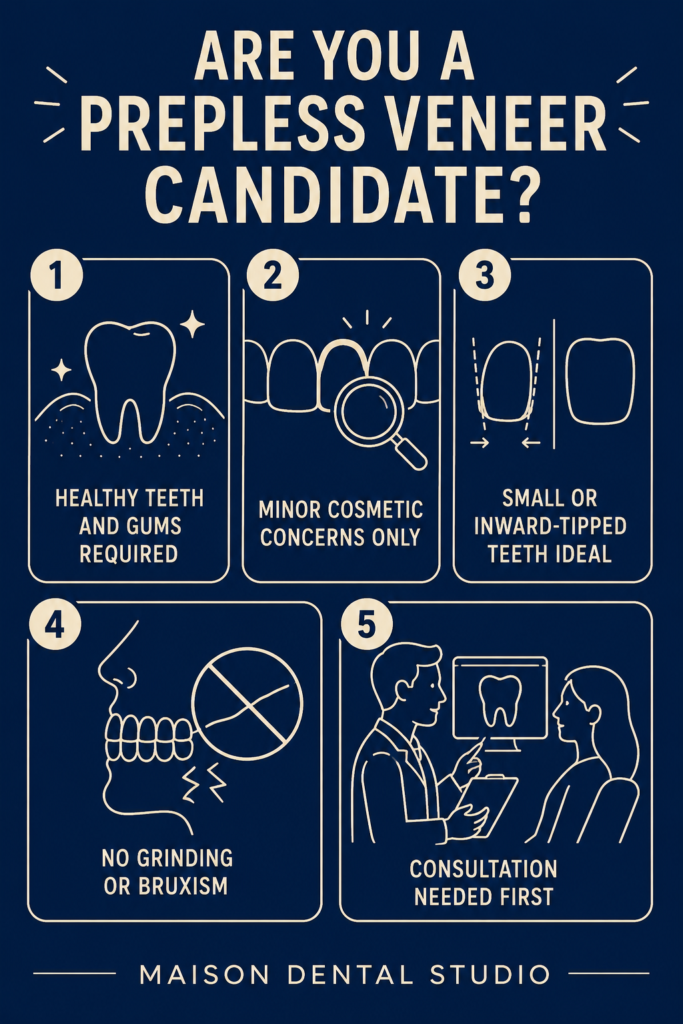
Not every patient is suited for prepless veneers, and a thorough consultation is always the necessary first step. However, several characteristics tend to make someone a strong candidate for this approach.
Healthy Teeth and Gums
The foundation of any successful cosmetic treatment is good oral health. Patients considering prepless veneers should be free of active tooth decay, gum disease, and significant structural damage. The best candidates for no-prep veneers have healthy teeth, good oral hygiene, and sufficient enamel, as the veneers rely on a strong enamel surface for proper bonding and long-term durability. Any underlying health concerns need to be addressed before cosmetic work begins. Dental veneers are custom-made to fit over the front surface of a tooth, and while they are generally safe, the enamel foundation is critical to the success of the bond.
Minor Cosmetic Concerns
Prepless veneers are best suited for patients looking to correct subtle imperfections rather than dramatic changes. They work well for minor cosmetic concerns such as small gaps, slight discoloration, or minor chips, but may not be effective for more severe issues like large gaps, major misalignments, or significantly damaged teeth. If your primary goals involve closing small spaces, brightening the appearance of stained teeth, or evening out slightly irregular edges, prepless veneers may align well with what you are hoping to achieve.
Teeth Positioned Inward or of Smaller Size
The geometry of your natural teeth plays a meaningful role in whether prepless veneers are appropriate. Patients with small teeth who want them to look more prominent, or those whose teeth are straight or tipped inward, tend to be strong candidates because the veneer can be added to the outer surface without creating a bulky or unnatural appearance. When teeth already protrude outward, adding a veneer on top without any preparation can make them look even larger, which is why this consideration matters during evaluation.
No Bruxism or Teeth Grinding
Patients who grind or clench their teeth are generally not ideal candidates for prepless veneers. Because these restorations are extremely thin, the repeated forces generated by bruxism can cause them to chip or fracture over time. If grinding is a concern, it does not necessarily rule out veneers entirely, but it is a factor that needs to be addressed and managed before moving forward with any veneer treatment.
Who May Not Be a Candidate?
Prepless veneers are not a one-size-fits-all solution, and honest candidacy evaluation is part of what makes the treatment worthwhile when it is the right fit. Patients with severely misaligned teeth, deep discoloration that the thin porcelain cannot fully mask, significant enamel erosion, or teeth requiring substantial reshaping may be better served by traditional veneers or another cosmetic approach. The goal is always to recommend the option most likely to produce a lasting, natural-looking result.
Finding Out If Prepless Veneers Are Right for You
The only way to know with confidence whether prepless veneers are appropriate for your smile is through a comprehensive in-person evaluation. Dr. Sam Mullen and Dr. Kaleb Murray graduated from the LSU School of Dentistry and completed a one-year Advanced Education in General Dentistry program, bringing a strong clinical foundation to every cosmetic consultation. Our advanced dental technology allows us to show you a preview of your potential results before any treatment begins, so you can make a fully informed decision with confidence.
If prepless veneers have caught your attention and you want to learn whether your smile is a good fit, schedule a consultation with Maison Dental Studio today. Our team is here to walk you through your options and help you find the path to the smile you have been envisioning.
Frequently Asked Questions About Prepless Veneers
What is the difference between prepless veneers and traditional veneers?
Traditional veneers require removing a thin layer of enamel from the tooth surface to create space for the restoration. Prepless veneers sit directly on existing tooth structure with little to no enamel removal, making them a more conservative option for the right candidate.
How do I know if I am a good candidate for prepless veneers?
The best way to determine candidacy is through an in-person evaluation. Generally, ideal candidates have healthy teeth and gums, minor cosmetic concerns such as small gaps or mild discoloration, and teeth that are smaller or positioned slightly inward. Patients with deep staining, severe misalignment, or significant enamel erosion may be better suited for traditional veneers.
Can prepless veneers close gaps between teeth?
Yes, prepless veneers can address minor to moderate gaps. They work best for small spaces where adding a thin porcelain shell creates a natural-looking result without making the tooth appear bulky. Larger gaps may require traditional veneers or an orthodontic approach depending on the extent of the spacing.
Are prepless veneers permanent?
Prepless veneers are a long-term cosmetic solution and are more reversible than traditional veneers since minimal enamel is altered. With proper care, including regular brushing, flossing, and dental visits, they can last for many years. Avoiding habits like biting hard objects and wearing a night guard if you grind your teeth helps extend their lifespan.
Do prepless veneers require special maintenance?
Prepless veneers do not require special care beyond a standard oral hygiene routine. Brushing twice daily, flossing, and attending regular dental cleanings are all that is needed. Patients who grind their teeth should discuss a night guard with their dentist to protect the thin porcelain from excessive force over time.
ABOUT THE AUTHOR
Dentist, Maison Dental Studio
Dr. Kaleb Murray graduated from the LSU School of Dentistry in 2022 and completed a one-year Advanced Education in General Dentistry residency. He is a Fellow of the International College of Oral Implantology and holds advanced training in IV moderate sedation, Invisalign, and cosmetic dentistry. Dr. Murray practices at Maison Dental Studio in Youngsville, Louisiana.